1956

#PérezPrado

Pérez Prado, nome completo José Dámaso Pérez Prado (Matanzas, 11 dicembre 1916 – Città del Messico, 14 settembre 1989), è stato un musicista, compositore e direttore d’orchestra cubano.

Considerato fra i maggiori artisti di musica latino-americana, è ricordato con l’appellativo di re del mambo ed è considerato uno degli eredi artistici di Xavier Cugat. Un altro soprannome che gli è stato attribuito è quello di El Cara de Foca (Volto di foca). La sua popolarità negli Stati Uniti coincise con quella di massimo interesse del mercato discografico e degli ascoltatori delle varie stazioni radio rispetto alla musica latino-americana.

Il suo nome è incluso fra quello delle celebrità della Hollywood Walk of Fame.

Dámaso Pérez Prado (Spanish pronunciation: [ˈpeɾes ˈpɾaðo]; December 11, 1916 – September 14, 1989) was a Cuban bandleader, musician (singer, organist and pianist), and composer. He is often referred to as the King of the Mambo.Pérez was his surname, thus Dámaso Pérez, his true name, became known by his paternal and maternal surnames Pérez Prado.

His orchestra was the most popular in mambo. His son, Pérez Prado, Jr., continues to direct the Pérez Prado Orchestra in Mexico City to this day.

Dámaso Pérez Prado est un compositeur et chef d’orchestre cubain, surnommé le roi du mambo, né le 11 décembre 1916 à Matanzas (Cuba), mort le 14 septembre 1989 à Mexico (Mexique).

Il apprend, enfant, le piano classique avec Rafael Somavilla. En 1942, il s’installe à La Havane où il joue du piano dans les cabarets, puis dans différents orchestres : Orquesta Cubaney, Orquesta de Paulina Alvarez, et dans le plus célèbre orchestre de Cuba, Orquesta Casino de la Playa. En 1947, il enregistre Qué rico el mambo et part en tournée en Argentine et au Venezuela.

En 1948, sa musique s’inspire du jazz de Stan Kenton, et les maisons de disques cubaines ne veulent plus l’enregistrer. Il part alors à Mexico où il engage comme chanteur Benny Moré. Il joue aussi comme acteur pour le cinéma. Il compose tellement de morceaux qu’il ne leur donne plus de noms, mais des numéros ; Mambo No. 5 et Mambo No.8 sont les plus connus.

Le 12 décembre 1949, sort un 78 tours comportant Qué Rico El Mambo sur une face et Mambo No. 5 l’autre. Ce disque va déclencher la « mambomania » (Mambo Craze) aux États-Unis.

En 1955, sa version cha-cha-cha de Cherry Pink and Apple Blossom White devient numéro un pendant 10 semaines au Billboard, le hit-parade américain. Ce morceau, en français Cerisier rose et Pommier blanc, avait été composé en 1950 par le français Louiguy (signataire officiel de La Vie en rose pour Édith Piaf), avec des paroles de Jacques Larue, chanté par André Claveau, puis devenu un classique du musette, repris par Petula Clark en 1964 et bien d’autres. Dans le film La Vénus des mers chaudes (Underwater), on voit Jane Russell danser sur Cherry Pink and Apple Blossom White.

En 1958, Patricia est un succès mondial (numéro un), utilisé en 1960 comme musique du film dans La Dolce Vita de Federico Fellini.

perez prado002 copia

http://youtu.be/qOuRWkLP-dA

#ArchivioCollezioneGarzia photographic exibithion in Rome

locandina definitiva 17ott

#MarleneDietrich #VittorioDeSica

Marie Magdalene “Marlene” Dietrich (Berlino, 27 dicembre 1901 – Parigi, 6 maggio 1992) è stata un’attrice e cantante tedesca naturalizzata statunitense. Fra le più note icone del mondo cinematografico della prima metà del Novecento, la Dietrich fu un vero e proprio mito, lasciando un’impronta duratura attraverso la sua recitazione, le sue immagini e l’interpretazione delle canzoni (arricchite da una voce ammaliante e sensuale). La Dietrich fu una delle prime dive grazie a un mix di qualità, raramente ripetuto dopo di lei, che fu sufficiente a farla entrare nella leggenda dello show business quale modello di femme fatale per antonomasia.

Il suo mito nacque e si sviluppò in contrapposizione a quello della divina Greta Garbo, entrambe star di punta di due compagnie di produzione rivali.

Marie Magdalene “Marlene” Dietrich (27 December 1901 – 6 May 1992) was a German actress and singer.

Dietrich remained popular throughout her long career by continually re-inventing herself, professionally and characteristically. In the Berlin of the 1920s, she acted on the stage and in silent films. Her performance as Lola-Lola in The Blue Angel (1930), directed by Josef von Sternberg, brought her international fame and garnered her a contract with Paramount Pictures in the US. Hollywood films such as Shanghai Express (1932) and Desire (1936) capitalised on her glamour and exotic looks, cementing her stardom and making her one of the highest-paid actresses of the era. Dietrich became a U.S. citizen in 1939,[3] and throughout World War II she was a high-profile frontline entertainer. Although she still made occasional films in the post-war years, Dietrich spent most of the 1950s to the 1970s touring the world as a successful show performer.

In 1999, the American Film Institute named Dietrich the ninth-greatest female star of all time.


Vittorio Domenico Stanislao Gaetano Sorano De Sica (Sora, 7 luglio 1901 – Neuilly-sur-Seine, 13 novembre 1974) è stato un attore, regista e sceneggiatore italiano.

Una delle figure preminenti del cinema italiano e mondiale, è stato inoltre attore di teatro e documentarista. È considerato uno dei padri del Neorealismo e, allo stesso tempo, uno dei più grandi registi ed interpreti della Commedia all’italiana.

Vittorio De Sica (7 July 1901 – 13 November 1974) was an Italian director and actor, a leading figure in the neorealist movement.

Four of the films he directed won Academy Awards: Sciuscià and Bicycle Thieves were awarded honorary Oscars, while Ieri, oggi, domani and Il giardino dei Finzi Contini won the Best Foreign Language Film Oscar. Indeed, the great critical success of Sciuscià (the first foreign film to be so recognized by the Academy of Motion Picture Arts and Sciences) and Bicycle Thieves helped establish the permanent Best Foreign Film Oscar. These two films generally are considered part of the canon of classic cinema.[1] Bicycle Thieves was cited by Turner Classic Movies as one of the 15 most influential films in cinema history.[2]

De Sica was also nominated for the 1957 Oscar for Best Supporting Actor for playing Major Rinaldi in American director Charles Vidor’s 1957 adaptation of Ernest Hemingway’s A Farewell to Arms, a movie that was panned by critics and proved a box office flop. De Sica’s acting was considered the highlight of the film.

Fonte wikipedia)

de sica e marlene dietrich W

Emilio Schuberth

Grande couturier amato dalle dive internazionali (per questo fu definito il “sarto delle dive”), vestì la principessa Soraya, Rita Hayworth, Ingrid Bergman, Bette Davis, Brigitte Bardot, Sofia Loren, Gina Lollobrigida e Anna Magnani. schubert018

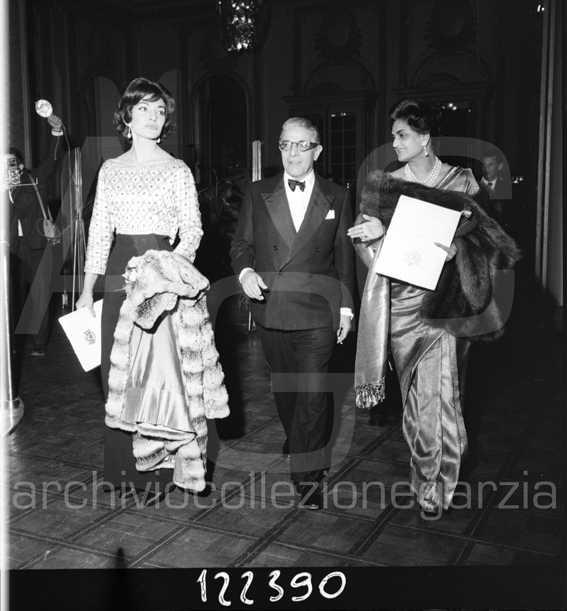
Maria Callas – Aristotele Onassis

Aristotle Onassis, the Greek ship owner, is shown with opera singer Maria Callas as they left the opera of Monte Carlo in 1960.  Right in photo is the Maharanee of Baroda.callas onassis monaco006