– Sammy Davis Jr. (Harlem, 8 dicembre 1925 – Beverly Hills, 16 maggio 1990) è stato un ballerino, cantante, vibrafonista, batterista, attore e comico statunitense.
Sammy Davis Jr. era figlio di due ballerini di Vaudeville, Sammy Davis Sr. e Elvera Sanchez. Il lavoro nel mondo dello spettacolo li teneva lontani da casa per lunghi periodi, così fu la nonna materna ad occuparsi di lui nei suoi primi anni di vita. Quando Sammy Davis Jr. aveva tre anni, i genitori si separarono. Suo padre, che non voleva perdere la custodia del figlio, lo portò in tournée con sé.
– Samuel George Davis Jr. (December 8, 1925 – May 16, 1990) was an American singer, dancer, actor and comedian. He was noted for his impressions of actors, musicians and other celebrities. At the age of three, Davis began his career in vaudeville with his father and Will Mastin as the Will Mastin Trio, which toured nationally. After military service, Davis returned to the trio. Davis became an overnight sensation following a nightclub performance at Ciro’s (in West Hollywood) after the 1951 Academy Awards. With the trio, he became a recording artist. In 1954, he lost his left eye in a car accident, and several years later, he converted to Judaism.[1]
Davis’s film career began as a child in 1933. In 1960, he appeared in the Rat Pack film Ocean’s 11. After a starring role on Broadway in Mr Wonderful (1956), he returned to the stage in 1964’s Golden Boy. In 1966 he had his own TV variety show, titled The Sammy Davis Jr. Show. Davis’s career slowed in the late 1960s, but he had a hit record with “The Candy Man” in 1972 and became a star in Las Vegas, earning him the nickname “Mister Show Business”.[2][3]
Davis was a victim of racism throughout his life, particularly during the pre-Civil Rights era, and was a large financial supporter of the Civil Rights Movement. Davis had a complex relationship with the black community, and drew criticism after publicly supporting President Richard Nixon in 1972 (although he later returned to being a Democrat). One day on a golf course with Jack Benny, he was asked what his handicap was. “Handicap?” he asked. “Talk about handicap. I’m a one-eyed Negro Jew.”[4][5] This was to become a signature comment, recounted in his autobiography, and in countless articles.[6]
After reuniting with Sinatra and Dean Martin in 1987, Davis toured with them and Liza Minnelli internationally, before he died of throat cancer in 1990. He died in debt to the Internal Revenue Service,[7] and his estate was the subject of legal battles.[8] Davis was awarded the Spingarn Medal by the NAACP and was nominated for a Golden Globe Award and an Emmy Award for his television performances. He was the recipient of the Kennedy Center Honors in 1987, and in 2001, he was posthumously awarded the Grammy Lifetime Achievement Award.
Brigitte Anne Marie Bardot, anche conosciuta come B.B. (“Bri-Bri” da bambina) (Parigi, 28 settembre 1934), è un’attrice, ex modella, cantante, ballerina e attivista francese.
Dopo gli esordi come danzatrice classica, diviene prima modella, posando per svariate copertine di riviste di moda, quindi attrice e infine, dal 1962, cantante. Negli anni del successo si consacrò come un’icona sexy. Dal 1962, inoltre, è un’attivista per i diritti degli animali, attività che l’ha assorbita completamente a partire dal suo abbandono del cinema avvenuto nel 1973.
Brigitte Anne-Marie Bardot (French: [bʁiʒit baʁˈdo]; born 28 September 1934) is a French actress, singer, dancer and fashion model, who later became an animal rights activist. She was one of the best known sex symbols of the 1950s and 1960s and was widely referred to by her initials, B.B.[
Bardot was an aspiring ballerina in her early life. She started her acting career in 1952. After appearing in 16 routine comedy films that had limited international release, she became world-famous in 1957 after starring in the controversial film And God Created Woman. Bardot caught the attention of French intellectuals. She was the subject of Simone de Beauvoir’s 1959 essay, The Lolita Syndrome, which described Bardot as a “locomotive of women’s history” and built upon existentialist themes to declare her the first and most liberated woman of post-war France. She later starred in Jean-Luc Godard’s 1963 film Le Mépris. For her role in Louis Malle’s 1965 film Viva Maria! Bardot was nominated for a BAFTA Award for Best Foreign Actress. From 1969 to 1978, Bardot was the official face of Marianne (who had previously been anonymous) to represent the liberty of France.
Bardot retired from the entertainment industry in 1973. During her career in show business, she starred in 47 films, performed in several musical shows and recorded over 60 songs. She was awarded the Legion of Honour in 1985 but refused to accept it.After her retirement, she established herself as an animal rights activist. During the 2000s, she generated controversy by criticizing immigration and Islam in France and has been fined five times for inciting racial hatred.
Brigitte Bardot (connue sous les initiales de « BB »), née le à Paris, est une actrice de cinéma, mannequin, chanteuse et militante de la cause animale française.
Figure féminine des années 1950 et 1960, elle est une star mondiale, l’égérie et la muse de grands artistes de l’époque. Emblème de l’émancipation des femmes et de la liberté sexuelle, elle passe des rôles de femme-enfant à ceux de femme fatale.
Elle tourne avec les plus grands réalisateurs, incarnant des personnages à l’élégante légèreté et à la sensualité photogénique. Elle devient rapidement un sex-symbol et acquiert une renommée internationale. Avec à son actif 45 films et plus de 70 chansons en près de 21 ans de carrière, Brigitte Bardot est une des artistes françaises les plus célèbres au monde.
En 1973, elle met un terme à sa carrière d’actrice et se consacre dès lors à la défense des animaux, notamment en présidant la fondation Brigitte-Bardot. À partir des années 1990, plusieurs de ses déclarations suscitent la controverse, en particulier lorsqu’elle critique les égorgements pratiqués par les musulmans et la montée de l’islam en France.
Nicola Arigliano (Squinzano, 6 dicembre 1923 – Calimera, 30 marzo 2010) è stato un cantante e attore italiano.
Noto al grande pubblico come interprete di successo nel panorama della musica leggera italiana, ha riscosso nella sua lunga carriera lusinghieri apprezzamenti anche come cantante di jazz.
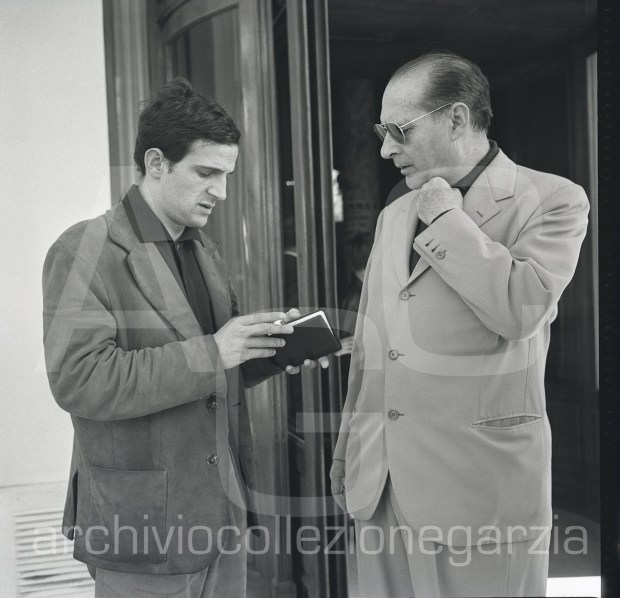
François Roland Truffaut (Parigi, 6 febbraio 1932 – Neuilly-sur-Seine, 21 ottobre 1984) è stato un regista, sceneggiatore, produttore cinematografico, attore e critico cinematografico francese. Importante protagonista del cinema francese tra gli anni sessanta e settanta, assieme agli amici e colleghi Jean-Luc Godard, Claude Chabrol, Éric Rohmer e Jacques Rivette diede vita a una nuova corrente cinematografica denominata nouvelle vague, letteralmente “nuova ondata”, che traeva ispirazione dalla passata stagione del Neorealismo italiano e che influenzerà successivamente numerosi registi americani della New Hollywood.
Roberto Gastone Zeffiro Rossellini (Roma, 8 maggio 1906 – Roma, 3 giugno 1977) è stato un regista, sceneggiatore e produttore cinematografico italiano.È stato uno dei più importanti registi della storia del cinema italiano, che ha contribuito a rendere noto al mondo con pellicole quali Roma città aperta (1945), Paisà (1946), Germania anno zero (1948) e Il generale Della Rovere (1959).
Walter Chiari, pseudonimo di Walter Annicchiarico (Verona, 8 marzo 1924 – Milano, 20 dicembre 1991), è stato un attore, comico e conduttore televisivo italiano.
Attore teatrale, cinematografico e televisivo, è stato uno dei più noti comici dello spettacolo italiano e uno degli esponenti di spicco della commedia insieme ad Alberto Sordi, Ugo Tognazzi, Vittorio Gassman, Marcello Mastroianni e Nino Manfredi.
Walter Chiari[ˈvalter ˈkjaːri], stage name of Walter Annicchiarico (8 March 1924 – 20 December 1991), was an Italian stage and screen actor, mostly in comedy roles.
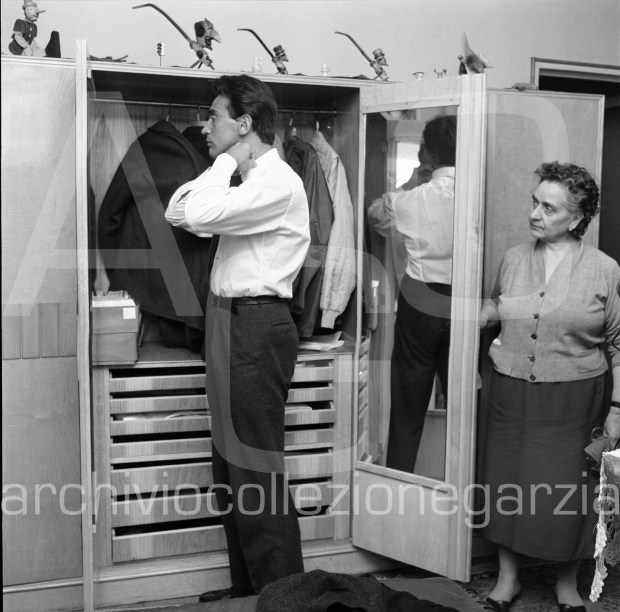
nella foto: Walter Chiari con la madre Enza maestra elementare nel 1952
David Niven, al secolo James David Graham Niven (Londra, 1º marzo 1910 – Château-d’Œx, 29 luglio 1983), è stato un attore britannico.
Arrivò a Hollywood durante gli anni trenta, iniziando a lavorare come comparsa in pellicole western. Firmò un contratto con il produttore Samuel Goldwyn e finalmente ebbe una parte più rilevante in La tragedia del Bounty (1935); da allora il suo successo crebbe grazie alle interpretazioni in La carica dei seicento (1936) e ne La voce nella tempesta (1939), e nelle commedie brillanti come L’ottava moglie di Barbablù (1938) e Situazione imbarazzante (1939).
Vinse l’Oscar al miglior attore protagonista per la sua interpretazione del timido e solitario maggiore Pollock in Tavole separate (1958), accanto a Deborah Kerr e Burt Lancaster, tratto dall’omonima commedia di Terence Rattigan.
Seguirono ruoli memorabili in drammi come Buongiorno tristezza (1958), in film bellici quali I cannoni di Navarone (1961) e I due nemici (1962), nel quale ebbe come partner Alberto Sordi, e in commedie sofisticate come La Pantera Rosa (1963) e James Bond 007 – Casino Royale (1967), commedia non appartenente alla serie ufficiale di film tratti dai romanzi di Ian Fleming, in cui interpretò il ruolo di James Bond.
Negli anni settanta venne acclamato da pubblico e critica per due brillanti libri autobiografici: La luna è un pallone (The Moon’s a Balloon) (1971) e Bring On the Empty Horses (1975), quest’ultimo mai tradotto in italiano. Nel 1981 pubblicò un romanzo d’amore e avventura ambientato a Londra durante la seconda guerra mondiale, Va piano, torna presto (Go Slowly, Come Back Quickly).
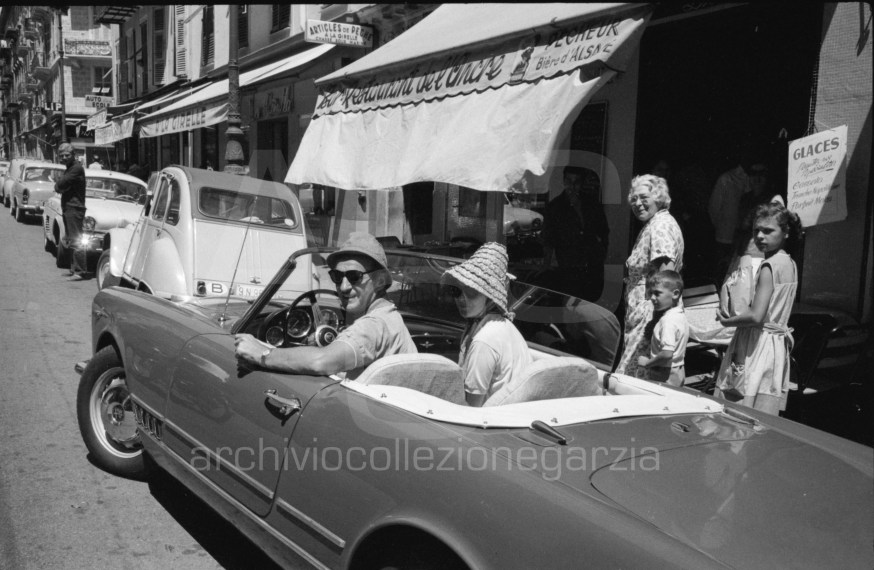
nella foto: David Niven con la seconda moglie Hjordis Paulina Tersmeden , in Belgio nel 1961
James David Graham Niven (1 March 1910 – 29 July 1983) was an English actor and novelist. His many roles included Squadron Leader Peter Carter in A Matter of Life and Death, Phileas Fogg in Around the World in 80 Days, and Sir Charles Lytton, (“the Phantom”) in The Pink Panther. He won the Academy Award for Best Actor for his performance in Separate Tables (1958).
Born in London, Niven attended Heatherdown Preparatory School and Stowe before gaining a place at the Royal Military College, Sandhurst. After Sandhurst, he joined the British Army and was gazetted a second lieutenant in the Highland Light Infantry. Having developed an interest in acting, he left the Highland Light Infantry, travelled to Hollywood, and had several minor roles in film. He first appeared as an extra in the British film There Goes the Bride (1932). From there, he hired an agent and had several small parts in films from 1933 to 1935, including a non-speaking part in MGM’s Mutiny on the Bounty. This brought him to wider attention within the film industry and he was spotted by Samuel Goldwyn. Upon the outbreak of the Second World War, Niven returned to Britain and rejoined the army, being recommissioned as a lieutenant.
Niven resumed his acting career after his demobilisation, and was voted the second-most popular British actor in the 1945 Popularity Poll of British film stars. He appeared in A Matter of Life and Death (1946), The Bishop’s Wife (1947), and Enchantment (1948), all of which received critical acclaim. Niven later appeared in The Elusive Pimpernel (1950), The Toast of New Orleans (1950), Happy Go Lovely (1951), Happy Ever After (1954) and Carrington V.C. (1955) before scoring a big success as Phileas Fogg in Michael Todd’s production of Around the World in 80 Days (1956). Niven appeared in nearly a hundred films, and many shows for television. He also began writing books, with considerable commercial success. In 1982 he appeared in Blake Edwards’ final “Pink Panther” films Trail of the Pink Panther and Curse of the Pink Panther, reprising his role as Sir Charles Lytton.
Alberto Sordi e David Niven nel film “I due Nemici”
Fred Buscaglione, nome d’arte di Ferdinando Buscaglione (Torino, 23 novembre 1921 – Roma, 3 febbraio 1960), è stato un cantautore, polistrumentista e attore italiano.
A Torino dal 1946, Fred aveva ricominciato a frequentare assiduamente l’amico Leo Chiosso, con il quale iniziò a comporre canzoni. Il rapporto tra i due era praticamente simbiotico, al punto che si trasferirono nello stesso palazzo, in due appartamenti dirimpetto l’uno all’altro, in Via Eusebio Bava 26 bis, in zona Vanchiglia. Trascorrevano giorni e notti intere insieme a chiacchierare a scambiarsi idee, battute e frasi musicali che Leo annotava e Fred accennava sulla tastiera del pianoforte.
Molto spesso si trattava di canzoni un po’ strampalate, che parlavano con ironia di “bulli e pupe”, di New York e di Chicago, di duri spietati con i nemici, ma sempre in balia delle donne e dell’alcool.
Nacquero così le canzoni che lo fecero conoscere in tutta Italia, molte delle quali eseguite dal vivo in concerto e registrate su disco, alcune in coppia con la moglie Fatima quali: Che bambola!, Teresa non sparare, Eri piccola così, Love in Portofino, Porfirio Villarosa (ispirata alla figura del celebre playboy Porfirio Rubirosa), Whisky facile.
Fred si calò nel personaggio, facendosi crescere un paio di baffetti e presentandosi in scena in doppiopetto gessato e cappello a larghe falde, ispirato a Clark Gable ed ai gangster americani come apparivano nei racconti hard-boiled di scrittori quali Damon Runyon, uno degli autori preferiti da Chiosso.
La sua discografia, nonostante la brevità della sua carriera, è folta. Nel 1956 incise numerosissime canzoni e in quello stesso anno uscirono i suoi primi 33 giri. Eppure non fu facile per lui trovare una casa discografica che accettasse di incidere quelle canzoni così trasgressive e inconsuete per l’epoca. Le sue prime incisioni risalgono al 1952, alcuni pezzi standard del repertorio jazz per l’etichetta La Voce del Padrone (oggi pressoché introvabili), ma nessuno si sentiva di dargli l’opportunità di incidere le “sue” canzoni.
Un aiuto decisivo arrivò dall’amico Gino Latilla, che aveva ottenuto un discreto successo con la canzone Tchumbala-bey scritta dal duo Chiosso-Buscaglione. Egli insistette tanto con il direttore della sua casa discografica, la Cetra, affinché lui gli lasciasse incidere le sue canzoni, al punto di anticipare di tasca propria le spese, e così nel 1955 vide la luce il primo singolo: un 78 giri che contiene due canzoni: Che bambola!/Giacomino. L’idea piacque al pubblico e il singolo vendette circa 980.000 copie in assenza di qualsiasi battage pubblicitario cosicché Buscaglione, incoraggiato da questo inaspettato successo, decise di incidere tante altre canzoni e sempre grazie all’appoggio di Latilla partecipò ad alcune trasmissioni radiofoniche, che contribuirono notevolmente alla sua nascente popolarità.
Ferdinando “Fred” Buscaglione (Italian pronunciation: [ˈfrɛd buskaʎˈʎoːne]; 23 November 1921 – 3 February 1960) was an Italian singer and actor who became very popular in the late 1950s. His public persona – the character he played both in his songs and his movies – was of a humorous mobster with a penchant for whisky and women.
Ferdinando Buscaglione was born in Turin, Italy on 23 November 1921. The son of a porter, his great passion for music appeared at a very young age. When he was 11, his parents enrolled him at the Giuseppe Verdi Conservatory in Turin. During his teen years, he performed at night clubs in Turin singing jazz and playing double bass and violin.
During World War II, he was incarcerated in an American internment camp in Sardinia. His musical talent was apparent and he was allowed to join the orchestra of the allied radio station of Cagliari. This permitted Buscaglione to continue to make music and to experiment with new sounds and rhythms coming from the U.S. (Most foreign music had been officially forbidden by the Italian Fascist regime.)
After the war, Buscaglione returned to Turin and resumed working as a musician for various bands. He then formed his own group, the Asternovas. During a tour in Switzerland in 1949 he met and married the half-German half-Moroccan entertainer Fatima Robin. In the meantime he was gradually creating his public character, inspired by Clark Gable and Mickey Spillane’s gangsters. His friend Leo Chiosso, a lyricist who wrote many of his songs, told him stories about gangsters and their babes, New York City and Chicago, tough men who were ruthless with enemies but easily fell victims to a woman’s charms. Together they wrote the hits that brought nationwide fame to Buscaglione: Che bambola (Whatta babe!), Teresa non sparare (Theresa, don’t shoot!), Eri piccola così (You were so small), Guarda che luna (Look, What A (beautiful) Moon), Love in Portofino, Porfirio Villarosa (a caricature of Porfirio Rubirosa), Whisky facile (Easy Whiskey).
After perfecting his routine in night clubs and theatres he started recording his songs in 1955; the first single (a shellac 78rpm record containing ‘Che bambola’ and ‘Giacomino’) sold 1,000,000 copies with close to no promotion, propelling him to a degree of fame he never considered possible.
By the end of the 1950s, Buscaglione was one of Italy’s most wanted entertainers. He appeared on advertising campaigns, on television, in movies.
At 38 years of age, he was killed in a car accident when his pink Ford Thunderbird collided with a truck in the early hours before dawn in Rome, of all places, right before the U.S. embassy. Only hours earlier he had dinner with some friends at a restaurant in Rome and met future Italian pop diva Mina Mazzini who made her Sanremo Music Festival debut earlier. The two discussed future collaboration that sadly never materialized.
Alongside his legacy, in songs and movies, Buscaglione deserves mention for having encouraged musicians and singers from the newer generation (the one influenced by the earliest forms of rock and roll) to stand up against the conservative producers and discographers of the time, demanding recognition for their art and their style. In this role he proved instrumental in the rise of the “yellers” scene which from the early 60s started to revolutionize the Italian popular music panorama
Gino Bramieri, all’anagrafe Luigi Bramieri (Milano, 20 giugno 1928 – Milano, 18 giugno 1996), è stato un comico, cantante e attore italiano di cinema e televisione.
Il suo debutto come artista risale alla fine del 1943, in uno spettacolo a favore degli sfollati nella piazza di Rovellasca. Il suo debutto teatrale, invece, a sedici anni (con un’unica battuta: «C’è una lettera per te!»), il 27 settembre 1944 al Teatro Augusteo di Milano, in Cretinopoli. Il suo primo vero spettacolo con pubblico pagante, infine, è all’Anteo, con: Brabito (dal nome dei tre protagonisti: Bramieri, Bisi, Tognato).
Ha lavorato con Franco e Ciccio, Peppino De Filippo, Aldo Fabrizi, Ave Ninchi, Nino Taranto, Raimondo Vianello, Totò. È stato interprete di oltre trenta film. In TV ottenne grande successo nel programma condotto da Corrado L’amico del giaguaro con Raffaele Pisu e Marisa Del Frate. Sulle reti Mediaset, negli ultimi anni della sua vita, è stato protagonista della sit-com Nonno Felice e del suo spin-off Norma e Felice.
Italo Terzoli ed Enrico Vaime sono stati i suoi autori “di riferimento”: con i loro copioni ha ottenuto grandi successi nel teatro leggero, da La sveglia al collo ad Anche i bancari hanno un’anima e La vita comincia ogni mattina (spettacoli prodotti, dalla fine degli anni sessanta, da Garinei e Giovannini, con i quali Bramieri cominciò la sua collaborazione nel 1969 con Angeli in bandiera in “ditta” con Milva).
È stato il conduttore, tra la fine degli anni sessanta e i primi anni settanta, del varietà radiofonico Batto quattro, sempre a firma di Terzoli e Vaime, in onda il sabato mattina sul Secondo Programma per il quale diede vita ad alcuni suoi personaggi/macchiette (famoso “il Carugati”). Negli stessi anni è stato protagonista di numerose serie di varietà televisivi trasmessi dalla RAI: Tigre contro tigre (1966), Il signore ha suonato? (1966), Eccetera, eccetera (1967), E noi qui (1970), Hai visto mai? (1973), Punto e basta (1975), della serie del G. B. Show (1982-88), sempre affiancato da grandi showgirl come Loretta Goggi, Sylvie Vartan, Lola Falana, oltre alla sua partecipazione in altri grandi varietà, come Milleluci, Felicibumtà. È stato tra i primi attori comici a partecipare – in gara – al Festival di Sanremo presentando nel 1962 i brani Lui andava a cavallo e Pesca tu che pesco anch’io.
Oltre a una grande maestria nel condurre scenette comiche e nel creare personaggi e macchiette, la sua specialità era quella di raccontare barzellette, che in genere erano molto brevi (a volte fatte di sole due battute, “botta e risposta”), e spesso un po’ surreali; di questa sua abilità amava dire: “Il problema di raccontare una bella barzelletta è che inevitabilmente ne fa venire in mente una orribile a chi l’ascolta”[1]. Questa sola particolarità lo rese maggiormente famoso, considerando soprattutto che le barzellette che sapeva raccontare erano svariate migliaia, peraltro raccolte in una serie di volumi tra cui 50 chili fa, ispirato alla forte perdita di peso che, a inizio anni settanta, consentì al grande comico milanese di trovare una nuova e più completa dimensione artistica. Una sua serie di pubblicità per Carosello, quella del Moplen, fu fra le più apprezzate dal pubblico.
Il 5 febbraio 1981, alla guida di un’Alfa 6, Bramieri si trovava con Liana Trouche, moglie di Aldo Giuffré, con cui stava recitando nelle repliche dello spettacolo di Terzoli e Vaime Felici e contenti, per la regia di Garinei e Giovannini. L’auto percorrendo l’autostrada A16 uscì fuori strada e l’attrice, che non indossava la cintura di sicurezza nonostante il mezzo ne fosse provvisto, fu sbalzata fuori dall’abitacolo e morì sul colpo.
Gino Bramieri al festival di sanremo 1962
Gino Bramieri[ˈdʒiːno braˈmjɛːri] (21 June 1928 – 18 June 1996) was an Italian comedian and actor. He was especially known as a television comedian, but also performed in theatres, on radio, and in about thirty movies. He was nicknamed “Il Re della barzelletta” (“the King of jokes”) for his burlesque comic style, which was largely based on his skill at telling funny stories.His jokes were sometimes as quick as a cut and thrust, and bordering on surrealism. They have been collected in a series of books, such as 50 chili fa (“50 kilos ago”, a collection he published after dieting).
Bramieri was born in Milan, Italy, into a humble family.He made his stage debut in 1943, with the prose company in prose of Egisto Olivieri.[2] He later graduated in accountancy at night school.In 1948 he got married and had a son.Bramieri’s career was launched by Erminio Macario, who entered him in his revue company in 1949. In his career, he has performed together with many prominent Italian comedians and actors, including Franco Franchi and Ciccio Ingrassia, Peppino De Filippo, Aldo Fabrizi, Ave Ninchi, Nino Taranto, Raimondo Vianello, Renato Rascel, and Totò. His career in television reached its apex in the 1960s–1970s, with RAI television shows such as Tigre contro tigre, Il signore ha suonato?, E noi qui and others; in the 1980s, he conducted a show named after him, the Gino Bramieri show (aka G.B. Show).
He died of cancer at the age of 67, and was buried in Milan’s Cimitero Monumentale, a privilege that is traditionally reserved to outstanding Milanese citizens.[4]
A street of Milan (district of Porta Nuova) as well as an avenue in Rome (in the Pineto city park) have been renamed in his honour.
Sir Alfred Joseph Hitchcock (Londra, 13 agosto 1899 – Los Angeles, 29 aprile 1980) è stato un regista e produttore cinematografico britannico naturalizzato statunitense[1]. È considerato una delle personalità più importanti della storia del cinema.
Lo spartiacque nella carriera di Hitchcock è rappresentato dal suo trasferimento da Londra a Hollywood, avvenuto nel 1940. In base a questa data, gli studiosi suddividono la sua produzione in due grandi periodi:
il periodo inglese, che va dal 1925 al 1940, durante il quale ha diretto ventitré film, di cui nove muti;
il periodo americano, che va dal 1940 al 1976, durante il quale ha diretto trenta film, fra i quali si annoverano i più conosciuti.
L’ultimo film è Complotto di famiglia diretto nel 1976.
Il regista è conosciuto anche, grazie ai suoi capolavori thriller, come “maestro del brivido”.
Nel 2012 è uscito nelle sale cinematografiche Hitchcock, con protagonisti Anthony Hopkins, Helen Mirren, Scarlett Johansson e Jessica Biel, film biografico incentrato sul rapporto tra il regista e sua moglie Alma Reville durante la lavorazione del film Psyco.
Sir Alfred Joseph Hitchcock KBE (13 August 1899 – 29 April 1980) was an English film director and producer, at times referred to as “The Master of Suspense”. He pioneered many elements of the suspense and psychological thriller genres. He had a successful career in British cinema with both silent films and early talkies and became renowned as England’s best director. Hitchcock moved to Hollywood in 1939, and became a US citizen in 1955.
With a career spanning more than half a century, Hitchcock fashioned for himself a recognisable directorial style. His stylistic trademarks include the use of camera movement that mimics a person’s gaze, forcing viewers to engage in a form of voyeurism. In addition, he framed shots to maximise anxiety, fear, or empathy, and used innovative forms of film editing. His work often features fugitives on the run alongside “icy blonde” female characters.
Hitchcock became a highly visible public figure through interviews, movie trailers, cameo appearances in his own films, and the ten years in which he hosted the television program Alfred Hitchcock Presents. In 1978, film critic John Russell Taylor described Hitchcock as “the most universally recognizable person in the world”, and “a straightforward middle-class Englishman who just happened to be an artistic genius”.
Hitchcock directed more than fifty feature films in a career spanning six decades and is often regarded as the greatest British filmmaker. He came first in a 2007 poll of film critics in Britain’s Daily Telegraph, which said: “Unquestionably the greatest filmmaker to emerge from these islands, Hitchcock did more than any director to shape modern cinema, which would be utterly different without him. His flair was for narrative, cruelly withholding crucial information (from his characters and from viewers) and engaging the emotions of the audience like no one else.”
Prior to 1980, there had long been talk of Hitchcock being knighted for his contribution to film. Critic Roger Ebert wrote: “Other British directors like Sir Carol Reed and Sir Charlie Chaplin were knighted years ago, while Hitchcock, universally considered by film students to be one of the greatest filmmakers of all time, was passed over”. Hitchcock later received his knighthood from Queen Elizabeth II in the 1980 New Year Honours.In 2002, the magazine MovieMaker named Hitchcock the most influential filmmaker of all time.
Marie Magdalene “Marlene” Dietrich/maɐ̯’le:nə ‘di:tʀɪç/ (Berlino, 27 dicembre 1901 – Parigi, 6 maggio 1992) è stata un’attrice e cantante tedesca naturalizzata statunitense.
Fra le più note icone del mondo cinematografico della prima metà del Novecento, la Dietrich fu un vero e proprio mito, lasciando un’impronta duratura attraverso la sua recitazione, le sue immagini e l’interpretazione delle canzoni (arricchite da una voce ammaliante e sensuale). La Dietrich fu una delle prime dive grazie ad un insieme di qualità, raramente ripetuto dopo di lei, che fu sufficiente a farla entrare nella leggenda dello show business quale modello di femme fatale per antonomasia. Il suo mito nacque e si sviluppò in contrapposizione a quello della divina Greta Garbo, entrambe star di punta di due compagnie di produzione rivali.
L’American Film Institute ha inserito la Dietrich al nono posto tra le più grandi star della storia del cinema.
-George Orson Welles (Kenosha, 6 maggio 1915 – Los Angeles, 10 ottobre 1985) è stato un attore, regista, sceneggiatore, scrittore, drammaturgo e produttore cinematografico statunitense.
È considerato uno degli artisti più versatili e innovativi del Novecento in ambito teatrale, radiofonico e cinematografico. Conquistò il successo all’età di ventitré anni grazie allo spettacolo radiofonico La guerra dei mondi, trasmissione che, leggenda narra, scatenò il panico in buona parte degli Stati Uniti, facendo credere alla popolazione di essere sotto attacco da parte dei marziani. Questo insolito debutto gli diede la celebrità e gli fece ottenere un contratto per un film all’anno con la casa di produzione cinematografica RKO, da realizzare con assoluta libertà artistica. Nonostante questa vantaggiosa clausola, solo uno dei progetti previsti poté vedere la luce: Quarto potere (1941), il più grande successo cinematografico di Welles, considerato “il più bel film della storia del cinema” secondo un sondaggio della rivista britannica Sight & Sound che ha interpellato oltre 250 critici e registi cinematografici.
La carriera successiva di Welles fu ostacolata da una lunga serie di difficoltà e inconvenienti che non gli permise di continuare a lavorare a Hollywood e che lo costrinse a trasferirsi in Europa, dove continuò a cercare di realizzare le proprie opere finanziandosi soprattutto con apparizioni in film altrui. Fra i suoi molti progetti, Welles riuscì a realizzare e dirigere film come: Macbeth (1948), Otello (1952), L’infernale Quinlan (1958), Il processo (1962), F come falso (1975) ed altri.
La sua fama è aumentata dopo la sua morte, avvenuta nel 1985, ed è considerato uno dei maggiori registi cinematografici e teatrali del XX secolo[]. Palma d’oro a Cannes nel 1952 (all’epoca Gran Prix du Festival), ricevette, tra gli altri riconoscimenti, l’Oscar alla carriera nel 1971. Nel 2002 è stato votato dal British Film Institute come il più grande regista di tutti i tempi. L’American Film Institute ha inserito Welles al sedicesimo posto tra le più grandi star della storia del cinema.
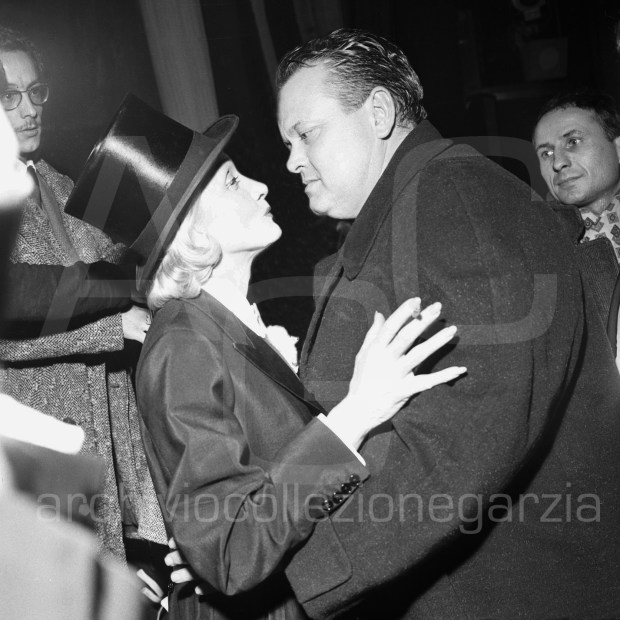
theatre de l’Etoile 1959
Marie Magdalene “Marlene” Dietrich (/mɑːrˈleɪnəˈdiːtrɪk/, German pronunciation: [maɐ̯ˈleːnə ˈdiːtʁɪç]; 27 December 1901 – 6 May 1992)was a German actress and singer who held both German and American citizenship.Throughout her unusually long career, which spanned from the 1910s to the 1980s, she maintained popularity by continually reinventing herself.
In the 1920s in Berlin, Dietrich acted on the stage and in silent films. Her performance as Lola-Lola in The Blue Angel (1930) brought her international fame and resulted in a contract with Paramount Pictures. Dietrich starred in Hollywood films such as Morocco (1930), Shanghai Express (1932), and Desire (1936). She successfully traded on her glamorous persona and “exotic” looks, and became one of the highest-paid actresses of the era. Throughout World War II, she was a high-profile entertainer in the United States. Although she still made occasional films after the war, Dietrich spent most of the 1950s to the 1970s touring the world as a marquee live-show performer.
Dietrich was noted for her humanitarian efforts during the war, housing German and French exiles, providing financial support and even advocating their US citizenship. For her work on improving morale on the front lines during the war, she received several honors from the United States, France, Belgium, and Israel. In 1999, the American Film Institute named Dietrich the ninth-greatest female star of classic Hollywood cinema.
George Orson Welles (/ˈwɛlz/; May 6, 1915 – October 10, 1985) was an American actor, director, writer, and producer who worked in theatre, radio, and film. He is remembered for his innovative work in all three: in theatre, most notably Caesar (1937), a Broadway adaptation of William Shakespeare’s Julius Caesar; in radio, the legendary 1938 broadcast “The War of the Worlds”; and in film, Citizen Kane (1941), consistently ranked as one of the all-time greatest films.
Welles directed a number of high-profile stage productions for the Federal Theatre Project in his early twenties, including an adaptation of Macbeth with an entirely African American cast, and the political musical The Cradle Will Rock. In 1937 he and John Houseman founded the Mercury Theatre, an independent repertory theatre company that presented a series of productions on Broadway through 1941. Welles found national and international fame as the director and narrator of a 1938 radio adaptation of H. G. Wells’ novel The War of the Worlds performed for his radio anthology series The Mercury Theatre on the Air. It reportedly caused widespread panic when listeners thought that an invasion by extraterrestrial beings was actually occurring. Although some contemporary sources claim these reports of panic were mostly false and overstated, they rocketed Welles to notoriety.
His first film was Citizen Kane (1941), which he co-wrote, produced, directed, and starred in as Charles Foster Kane. Welles was an outsider to the studio system and directed only 13 full-length films in his career. He struggled for creative control on his projects early on with the major film studios and later in life with a variety of independent financiers, and his films were either heavily edited or remained unreleased. His distinctive directorial style featured layered and nonlinear narrative forms, uses of lighting such as chiaroscuro, unusual camera angles, sound techniques borrowed from radio, deep focus shots, and long takes. He has been praised as “the ultimate auteur”.
Welles followed up Citizen Kane with critically acclaimed films including The Magnificent Ambersons in 1942 and Touch of Evil in 1958. Although these three are his most acclaimed films, critics have argued other works of his, such as The Lady from Shanghai (1947) and Chimes at Midnight (1966),are underappreciated.
In 2002, Welles was voted the greatest film director of all time in two British Film Institute polls among directors and critics,and a survey of critical consensus, best-of lists, and historical retrospectives calls him the second most acclaimed director of all time (behind Alfred Hitchcock). Known for his baritone voice, Welles was an actor in radio and film, a Shakespearean stage actor, and a magician noted for presenting troop variety shows in the war years.




 archiviocollezionegarzia.com